When aluminum foil tape is applied to a straight, flat surface, handling is usually straightforward. The situation changes when the tape needs to follow a pipe bend, cover a duct corner, or fit around an equipment housing with several changes in direction. In these applications, the reinforcement structure can affect how easily the tape conforms to the surface and how well it handles during application.
Woven Fiberglass Mesh Aluminum Foil Tape is designed for applications where an open reinforcement structure and a moisture-resistant foil-based construction are useful. Available in 3×3 and 5×5 mesh patterns, this tape offers different structural configurations for industrial insulation and surface protection. Understanding what the mesh pattern means—and what it does not tell you—is an important step when choosing a suitable specification.
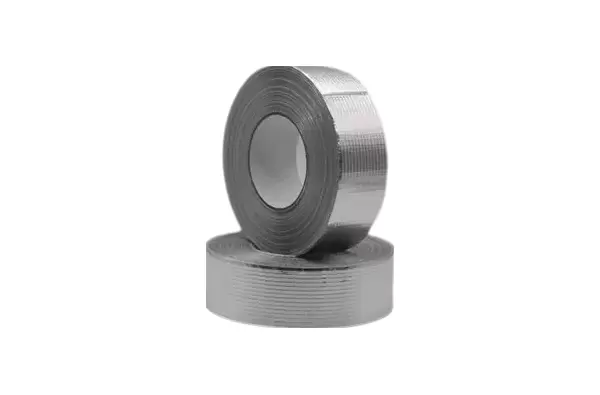
What Does a 3×3 or 5×5 Mesh Pattern Mean?
The mesh pattern describes the arrangement of the woven reinforcement. A 3×3 pattern and a 5×5 pattern have different grid configurations, but the numbers alone do not establish the exact opening size, strand thickness, or reinforcement weight. Those details depend on the material construction and manufacturing specifications.
For buyers, the practical question is how the selected mesh performs in the intended application. A tape used on a relatively straight ventilation duct may have different handling requirements from one applied around a narrow pipe bend or an irregular equipment corner.
An open mesh structure can provide greater flexibility than a denser reinforcement construction, depending on the yarn, weave, coating, and overall laminate design. However, it would be inaccurate to assume that every 3×3 mesh tape is more flexible than every 5×5 version without comparing their actual construction and test results.
The mesh pattern should therefore be evaluated alongside total thickness, adhesive characteristics, liner type, and the geometry of the surface being covered.
How Mesh Density Influences Flexibility and Conformability
Flexibility matters most when the tape must follow a surface that is not perfectly flat. Around a curved pipe, for example, the tape needs to conform to the changing surface without excessive wrinkling, bridging, or lifting at the edges.
An open mesh reinforcement can help the laminate adapt to irregular shapes. This is particularly useful when covering corners, transitions, and curved sections of insulated equipment. The tape can be easier to position in these areas than a construction with a less adaptable reinforcement, although the actual result also depends on the foil layer, adhesive, and application technique.
A denser weave may provide a different distribution of reinforcement across the tape. Whether that difference improves handling or dimensional stability depends on the specific materials and manufacturing process. Buyers should not select a pattern based on mesh count alone.
There is also a trade-off between flexibility and tensile strength. According to the product specifications, the reduced density of the mesh structure can result in lower tensile strength than standard fiberglass cloth tape, while offering greater flexibility. This distinction is important when the tape must conform to complex surfaces but is not intended to carry substantial mechanical loads.
In practice, flexibility helps with positioning and coverage; it does not mean the tape can compensate for a damaged insulation layer, support heavy components, or withstand unlimited pulling force during installation.
Comparing the Available 3×3 and 5×5 Specifications
The available product configurations provide a useful starting point for technical evaluation.
Parameter | 3×3 Mesh | 5×5 Mesh |
Total thickness | 130 μm | 130 μm or 120 μm |
Adhesive type | Solvent-based | Solvent-based or water-based |
Release liner | Kraft paper | Yellow paper |
Available size | 120 mm × 100 m | 50 mm × 50 m or 1220 mm × 900 m |
180° peel strength | ≥ 6 N/cm | ≥ 6 N/cm for solvent-based; ≥ 4 N/cm for water-based |
Initial tack | ≥ 10# | ≥ 10# |
Holding power | ≥ 24 h | ≥ 24 h |
Tensile strength | ≥ 40 N/cm | ≥ 40 N/cm |
These values describe the listed product configurations, not universal performance values for every tape with the same mesh pattern. The adhesive type, total thickness, and other construction details differ between some of the available options.
For example, the 3×3 version has a listed total thickness of 130 μm, a solvent-based adhesive, and a kraft paper liner. One 5×5 version also has a thickness of 130 μm and solvent-based adhesive, but uses yellow release paper. Another 5×5 configuration has a thickness of 120 μm and uses a water-based adhesive.
This means a buyer comparing the 3×3 and 5×5 products should distinguish between the effects of the mesh and those of the complete tape construction. The available figures do not establish that one pattern is inherently more flexible or stronger than the other.
For a fair comparison, request samples of the intended specifications and evaluate them under the same application conditions. Bending behavior, edge adhesion, ease of handling, and compatibility with the insulation surface can then be assessed directly.
Choosing a Mesh Pattern for Pipe and Duct Insulation
Pipe and duct insulation is one of the primary applications for this type of tape. The best specification depends on the shape of the insulated surface, the condition of the outer facing, and the way the tape will be applied.
For straight duct sections, buyers should consider the required tape width, overlap, adhesive compatibility, and the condition of the surface. A narrower roll may be easier to position around small transitions, while wider material may be suitable for covering larger areas when the application method supports it.
Curved pipe sections and duct elbows require closer attention to conformability. Tape that does not follow the surface evenly can wrinkle or bridge across a corner, leaving parts of the insulation facing poorly covered. The open mesh design of Woven Fiberglass Mesh Aluminum Foil Tape can be beneficial in these situations, but the final result still depends on selecting the correct width and applying the tape without excessive tension.
Before full-scale use, test the tape on the actual insulation facing. Dust, moisture, surface coatings, and uneven substrates can affect adhesion. The tape should be applied without stretching it unnecessarily, and the edges should be checked for lifting after application.
It is also important to distinguish between covering an insulation joint and creating a certified airtight or watertight system. The tape may help cover and protect a joint, but the complete assembly must be assessed against the performance requirements of the project.
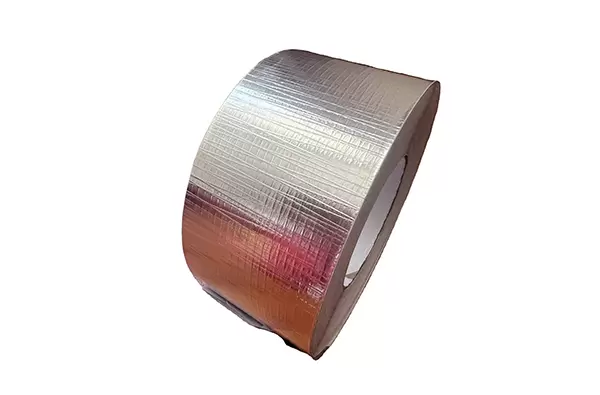
Applying the Tape Around Equipment Corners and Irregular Surfaces
Outdoor equipment often includes corners, curved housings, panel transitions, and other areas where a flat strip of tape may be difficult to position. A flexible mesh-reinforced tape can be useful for covering these locations, provided the substrate and environmental conditions are suitable.
Start by identifying the most difficult sections of the surface. Tight corners, changes in direction, and transitions between different materials deserve particular attention because they can create stress points at the tape edges.
Clean and dry the surface before application, following the relevant equipment and adhesive requirements. Position the tape gradually instead of pulling it tightly across the curve. Press it into contact with the surface and inspect the edges for wrinkles, trapped air, or incomplete contact.
The PE-laminated layer provides a moisture barrier against water penetration through the intact film. However, the performance of a completed installation also depends on overlaps, cut edges, joints, and damage to the laminate. A material-level moisture barrier should not be interpreted as a guarantee that every taped assembly will remain waterproof under all conditions.
Fire performance also requires careful consideration. PE is inherently flammable unless suitable flame-retardant additives are incorporated. Where the tape is intended for infrastructure fire protection or another regulated application, buyers should verify the exact product formulation, applicable test reports, and project approval requirements rather than assuming that an aluminum foil surface makes the complete tape fire-resistant.
Adhesive Type and Release Liner Matter Too
Mesh pattern is only one part of the specification. Adhesive performance determines how the tape bonds to the intended substrate, while the release liner affects handling before application.
The listed solvent-based versions have a minimum 180° peel strength of 6 N/cm, whereas the listed water-based version has a minimum value of 4 N/cm. Both configurations have a stated initial tack of at least 10# and holding power of at least 24 hours. These figures should be interpreted according to the manufacturer's test methods and the actual conditions under which the tape will be used.
The solvent-based options have a listed shelf life of 12 months. Water-based and flame-retardant adhesive versions have a listed shelf life of 6 months. Store the tape in a cool, dry environment at temperatures from -5°C to 40°C and relative humidity below 80%. Keep it away from direct sunlight and heat sources.
Release liner selection should also match the converting or application process. The listed 3×3 configuration uses kraft paper, while the 5×5 configurations use yellow paper. Buyers who need a particular roll width, liner, or adhesive system should confirm the complete specification before ordering rather than treating mesh count as the only purchasing criterion.
What Buyers Should Confirm Before Ordering
For industrial procurement, the most useful specification is the one that matches the actual working conditions. Before placing an order, confirm the following:
l Mesh pattern: Specify 3×3 or 5×5 and request construction details if the opening size or reinforcement weight is critical.
l Total thickness: The available configurations are listed at 120 μm and 130 μm.
l Adhesive type: Confirm whether the application requires a solvent-based or water-based adhesive.
l Peel strength and tack: Check the stated values against the substrate and service requirements.
l Roll dimensions: Confirm the required width and length, particularly for automated processing or large insulation projects.
l Tolerance requirements: The listed tolerances are ±0.005 mm for aluminum foil thickness, ±0.01 mm for total thickness, ±0.5 mm for width, and ±0.2 m for length.
l Service conditions: Confirm temperature exposure, moisture conditions, fire-related requirements, and compatibility with the insulation facing.
Working with a manufacturer that understands these details can help reduce specification mismatches. Jiangyin Biaotie Material Factory Co., Ltd. has specialized in tape manufacturing since 1980 and offers application-focused communication and customization support. By discussing the intended substrate, installation environment, and required roll format, buyers can evaluate whether an existing configuration meets their needs or whether further specification adjustments are necessary.
Make the Mesh Pattern Work for the Application
The difference between 3×3 and 5×5 mesh patterns should be assessed as part of the complete tape construction, not as an isolated number. Flexibility, tensile strength, adhesive performance, total thickness, and surface geometry all contribute to how a tape performs in practice.
For pipeline and duct insulation, curved transitions, and equipment corners, sample testing can reveal handling differences that a specification table alone cannot fully explain. Buyers should compare the exact available configurations under consistent conditions and verify that the selected tape meets the project's performance and safety requirements.
For application-specific guidance or specification confirmation, Woven Fiberglass Mesh Aluminum Foil Tape from Jiangyin Biaotie Material Factory Co., Ltd. is a practical starting point for discussing mesh configuration, adhesive type, roll dimensions, and intended use. Selecting the tape around the real working conditions helps make the final choice more reliable than relying on mesh count alone.

 WhatsApp